
The Haynes Story
By Gibbon Simmons, Conservation Delivery Specialist, KS
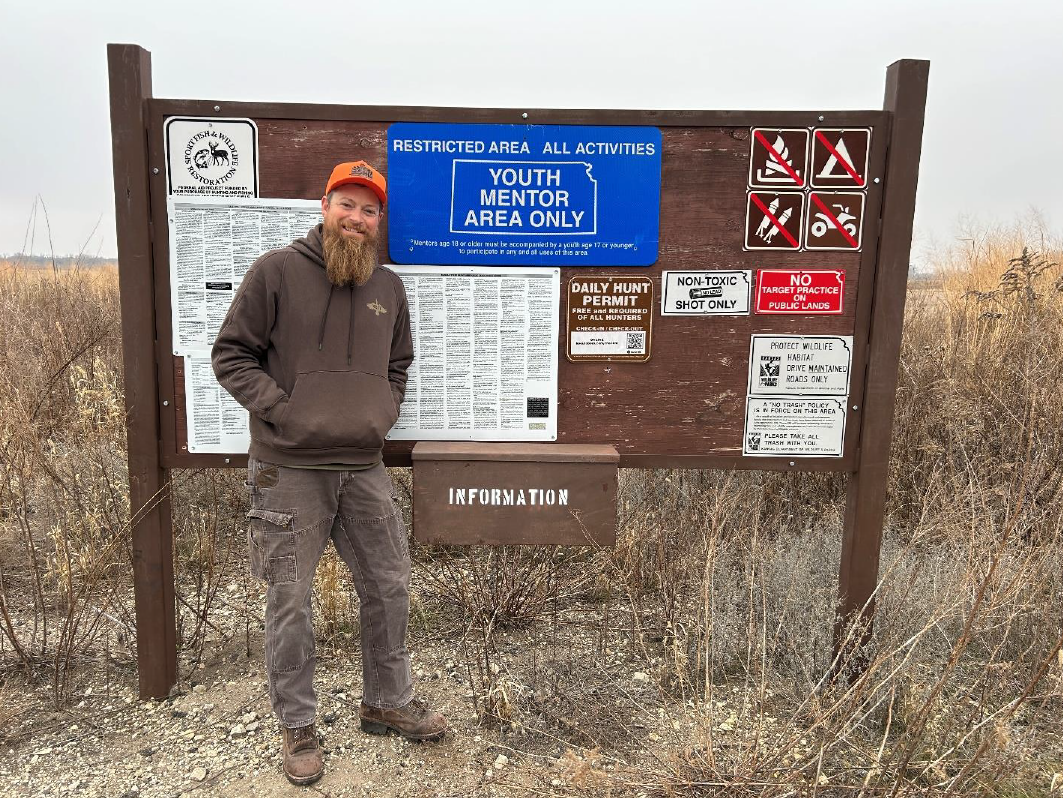
Did you know Pheasants Forever and Quail Forever (PFQF) is working with the Kansas Department of Wildlife and Parks (KDWP) to manage wildlife habitat in Clay County? Our very own Russell Haynes works at the Milford Wildlife Area as a Habitat Specialist thanks to a partnership between PFQF / KDWP.
Milford Wildlife Area offers residents and visitors of Clay County 19,000 acres of public land open to hunting and outdoor recreation. Haynes plays a key role in shaping the landscape. Carefully planning and implementing conservation practices makes up most of his days.
Fighting back against woody encroachment is a large part of Haynes’s plan. Encroaching trees are cut or mulched. “I spot spray the stumps because most will resprout” describes Haynes. This type of chemical application is targeted, minimizing harmful effects to the surrounding habitats.
Restoring fire to the landscape is a critical part of the management plan. Haynes constructed permanent firebreaks to practice prescribed burning safely and aggressively. The Milford Wildlife Area team burned 2,000 acres in 2025. One example is a place where he burned a variety of Switchgrass called Kanlow. The grass grew exceptionally well after the burn, towering at least 7ft tall and growing in bunches. The grass provides upland birds escape cover from predators as well as thermal cover. Frequent burning maintains healthy grasslands by setting back the transition of grasslands to woodlands. “The benefits of burning outweigh the consequences of fire suppression,” says Haynes.
Haynes’s most fulfilling project of 2025 was a series of native grass plantings. The largest of these was 215 acres. Talk about using lemons to make lemonade. Blame it on broken infrastructure or the 2020 flood; but some of Milford’s wetland areas are dysfunctional. Haynes took an adaptive management approach to create new grassland habitat in one of these dysfunctional wetlands. What a thrill to see the grass come up in the first year! The other grass plantings occurred on former ag land. The Milford Wildlife Area management plan includes special ag leases. These ag leases generate revenue to fund conservation efforts on the wildlife area. But many of these fields are small acreages. Diminishing returns on these fields are prompting lessees not to renew their lease agreements. Haynes identified thirty such fields, the smallest field being 1.2 acres. He planted 400 acres total to native grass in 2025, creating new wildlife habitats.
Motivation matters. Haynes’s motivation is this: “It’s not ours, it’s just our turn,” a quote he heard from conservationist Doug Duren. Grateful for the recreational benefits passed down from generations before, Haynes believes it worthwhile to attentively steward wildlife habitats for generations hereafter.
The PFQF / KDWP partnership supports up to 20 additional Habitat Specialist positions advancing a shared mission for wildlife on public and private lands. Though we fill different roles, Haynes and I are members of the PFQF Kansas Team. Our team is working to conserve upland habitats statewide. We stand with private landowners, NGOs, local, state, and federal agencies to tackle conservation issues. Help us by doing your part to improve upland habitats.
Pheasants Forever's mission is to conserve pheasants, quail, and other wildlife through habitat improvements, public access, education, and conservation advocacy.