
Monitoring Woody Encroachment: The Early Phases
By Gibbon Simmons, Conservation Delivery Specialist, KS
Are you reaping the consequences of someone else’s assumption? “It’ll never happen here” they said not very long ago. They assumed woody encroachment would never touch the place and now it’s there. You’ve witnessed firsthand how it spread from one side clear up the hill and down the draw. Maybe you’ve even tried to knock it back, cutting them all down, but more grew up to replace the ones you cut. One critical step many people miss when managing brush is monitoring the early phases of woody encroachment.
Intact Phase
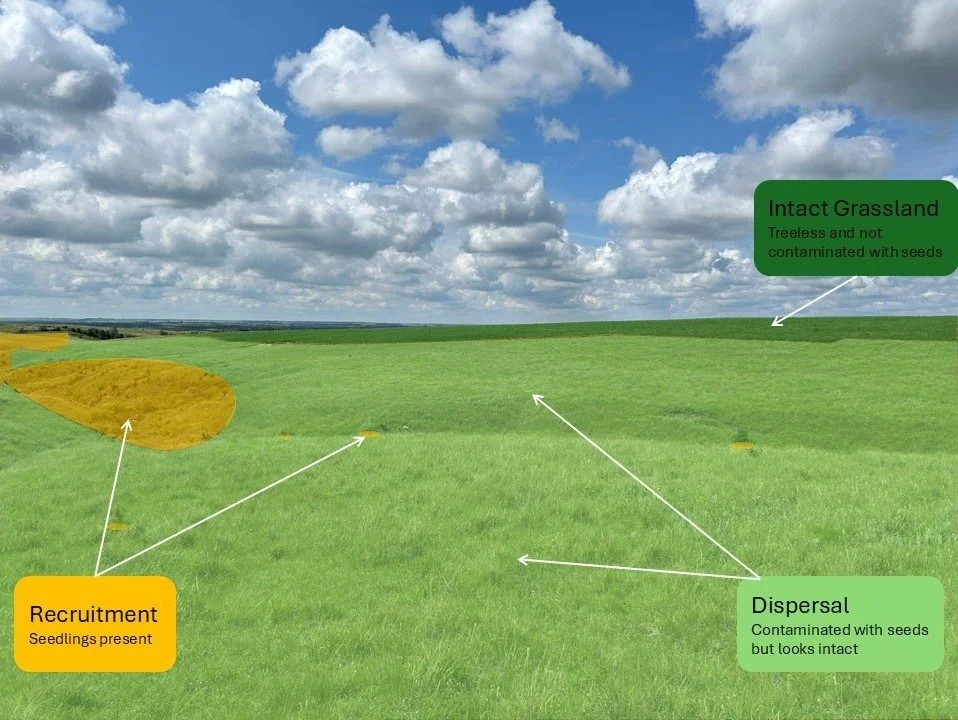
Kansas grasslands are no longer intact when they become contaminated by the seeds of invasive trees. Monitoring is recommended to evaluate the proximity of intact grassland sites to seed sources, and their proximity to the expanding regional threat of woody encroachment. Monitoring during the intact phase should answer the following questions: How close is my site to the nearest seed source? Where is the regional threat of woody encroachment coming from? At what rate is it expanding? Answers to these questions can give you a headstart in preparing for future changes as woody encroachment continues to expand its shadow across the Great Plains.
Dispersal Phase
Grasslands in the dispersal phase are contaminated by seed. In the absence of fire, these areas transition to the recruitment phase, the next phase of the encroachment process. Tracking this phase comes down to on site, field monitoring and measurements of effective seed dispersal distances. Take Eastern Redcedar for example, seed dispersal is most effective within the first 200 yards. A prediction of where dispersal is occurring can be made quite accurately by measuring a radius the distance of the most effective seed dispersal. 200 yards in every direction of a seed source equates to about a 26 acre circle of contaminated land.
Recruitment Phase
Recruitment is the process of seeds becoming seedlings, resulting in exponential population expansion. Ask yourself this question, “Is seedling recruitment present on site?”
If no, then annual monitoring is still recommended. Early detection provides a target area for control treatments. Remember, recruitment is expected on contaminated sites. Taller seedlings are easily observed above the grass. However, don’t assume recruitment isn’t occurring if you didn’t spy the smaller seedlings hidden in the grass. Field monitoring is the best way to search for hidden seedlings. Be sure to keep an eye on areas nearest off site seed sources.
If yes, don’t allow seedlings to mature. Note all areas where recruitment is present and begin control treatments. Grassland restoration requires long-term commitment and several monitoring missions. Control treatments will need to be repeated over multiple years to suppress reinvasion. Don’t believe the myth of single treatment restoration (Twidwell et. al, 2021). Research shows rapid reestablishment and recovery of woody plants following restoration treatments due to long-term exposure to seed sources on or near the site (Fogarty et. al, 2025). The timeline for control/suppression depends on the life history of the woody species (e.g., seed longevity) and its interaction with site conditions. Once new recruits stop showing up, the site should be annually monitored to determine if the seedbank has been depleted.
If it’s time for a monitoring mission on your site, then take one final thing from this article. The Kansas Pheasants Forever and Quail Forever biologist team stands ready to assist. Our team members have keen eyes for spotting the needle in the haystack, or seedling in the tallgrass. Visit www.kansaspfqf.org/our-team to find a biologist near you.
References
Twidwell D., Fogarty D.T., Weir J.R., July 2021. Reducing Woody Encroachment in Grasslands A Guide for Understanding Risk and Vulnerability. Oklahoma Cooperative Extension Service, Division of Agriculture Sciences and Natural Resources, Oklahoma State University. E-1054.
Fogarty D.T., Beadle M., Allen C.R., Bielski C., Twidwell D., January 2025. Woody Plant Reinvasion Shortens the Lifespan of Grassland Restoration Treatments. Journal of Environmental Management, Volume 374. 2025. 124020.